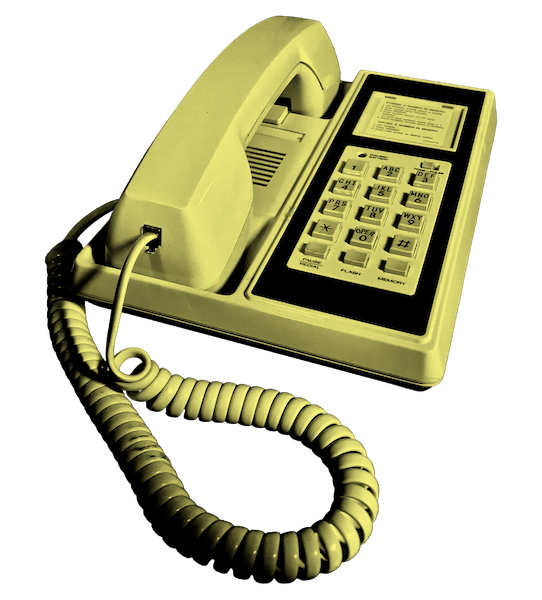
Issue 1: Landline
For the first issue of Every Object an Archive, we're conducting exit interviews for the landline telephone.
The landline was a commonplace piece of household technology. It was also a physical object, almost a piece of furniture — physically fixed in place, shared by family members, and woven into the routines of daily life.
As the cellphone and internet technology replaced the landline for most people, the basic calling function of the telephone survived. However, many of the ancillary behaviors and cultural habits that evolved alongside the landline fell away.
The research
Our research for Landline is grounded in a series of in-depth qualitative interviews with people aged over 40 from the San Francisco Bay Area in the United States and New Zealand’s Greater Wellington Region (our home bases). We are focused on the period between the 1970s and early 2000s, when the landline was a mature technology and before the cellphone became the dominant method for calling.
We are asking people about their experiences with landline telephones: where the phone lived, what it looked and felt like, who answered it, how privacy was navigated, how families negotiated access, and how it affected the ways people made plans and moved around in the world.
These interviews form the basis for our analysis and insights. As of September 2026, we are currently completing the interview research and analysis phase of Issue 1: Landline.
What we’re finding
The themes and insights that are emerging from our interviews highlight the varied and specific kinds of connection, independence, physicality, and household interaction that were built into the landline system. These include:
Learning conversational independence: children learned to interact one-on-one with adults outside their family, and absorbed the conversational norms of the adult world.
Physical catch-up spots: when people were out of the house, they were often uncontactable by phone. Established physical hangout spots became important social hubs that let young people find each other and communicate while out of the house.
Navigating shared resources: the landline was a site for interpersonal skill development within households. For example, young adults learned to make collective financial decisions, and siblings learned to negotiate limited phone time.
Constraints facilitated other forms of communication: the expense of long-distance calling and the physical boundedness of the landline meant that long-distance relationships were maintained in temporally diverse ways — letter writing, emails.
An initial report will be published in late 2026
Following the completion of our interview and analysis phase, we will be writing up key themes and insights from the research to present as a report for a broad audience including technologists, policy makers, service designers, and people interested in technological transitions and material culture. The report will touch on potential implications for contemporary technology and service design and consider what the findings might mean for policymakers.
Next steps
In addition to the research report, we are interested in extending the Landline research in a few potential directions. This might include:
developing a framework for identifying “lost affordances” in technological transitions
creating additional public-facing writing, talks, or other forms of storytelling
working with designers, technologists, historians, and researchers to expand or interpret the findings
collaborating with GLAM institutions on related exhibitions or programming.
We are also exploring what additional technologies to tackle in future issues of the Every Object an Archive project.
Please get in touch if you’re interested in exploring any of these opportunities with us.
Work with us:
Fund the next phase of research
Partner on research, design, or public programming
Commission an issue about a technology you care about
Suggest a future object