Every Object an Archive
Every Object an Archive is a research project about what happens when once-ubiquitous technologies disappear
We interview people about their experiences with technological objects that were once everywhere, but are now being replaced or redesigned. We are interested in the physical experience of living with these objects, their handfeel and relationships to our bodies. We are also interested in how they shaped our habits, relationships, and ways of being. Technologies are more than physical objects: whole worlds of infrastructure, process, policy and culture are built around them.
Our first object of investigation is the landline telephone.
What we’re researching
No technology stands alone. A mature technology is part of a sociotechnical ecosystem that shapes our lives, including the ways we experience space, perceive time, and build relationships. Through its design and system of use, the technology provides certain affordances — that is, it offers possibilities for certain kinds of behavior while making other kinds more difficult.
What happens, then, when a specific technology falls out of use?
The replacement technology may be faster, cheaper, more convenient, or simply different. But the transition is rarely a one-to-one exchange. Along with the physical object, some of the practices and experiences that accumulated around it may disappear too. We want to understand what those clusters of behavior and experience are — or were.
Through interviews, research, and analysis, Every Object an Archive asks:
What do we gain when a technology changes?
What do we lose?
What might be worth carrying forward?
Why this is important
By understanding the behaviors, cultural patterns, and physical experiences enabled by different technologies, we can build a better picture of what can be lost in moments of transition.
We are particularly interested in social affordances: the behaviors and experiences that a technology makes easier or more likely to occur. Some of these behaviors and practices were undoubtedly socially beneficial. Others were necessitated by the technological system but are no longer relevant. And some were challenging or harmful, and can be left happily behind.
Our research asks whether identifying these lost but socially beneficial clusters of behavior can help us think differently about the technologies we design (or redesign) next. How might we design objects and systems to reintroduce some of these older practices and material pleasures? And what does it look like to make active decisions during moments of technological transition?
An evolving research program
Landline is the first issue of Every Object an Archive, and serves as proof of concept for a larger research program.
Our initial findings from Landline will be shared in a research report, which will include:
original interview-based research with people who lived with the technology
research into the material, technological, and historical conditions surrounding the technology
analysis of the behaviors and ways of being that developed around it
documentation of how behavior changed as the technology evolved
ideas for what might be retained, reintroduced, or designed back into contemporary life.
Future issues could cover a range of other technologies — both major and minor — that have moved from ordinary infrastructure to historical artifact. On our mind currently are objects like the check book (cheque book), the digital printer, the box office.
What’s next
We see several possible directions for Every Object an Archive. Along with additional issues focused on other technologies, we are interested in expanding the project: growing the archive of interviews and oral histories, designing publications and reports for different audiences, collaborating with designers and technologists, partnering with museums, galleries or research institutions, and trying experiments that translate the research into new tools, policies, or concepts for the future.
We are interested in finding partners who would like to explore these questions with us. This could be through research, commissioning, funding, co-design, convening, or other forms of collaboration.
If you’re interested in Landline, future issues of Every Object an Archive, or opportunities for collaboration, we’d love to hear from you.
About the researchers
Every Object an Archive is led by Kelly Pendergrast and Anna Pendergrast, writers and researchers based in Oakland, California (Kelly) and Wellington, New Zealand (Anna). Together they lead Antistatic, a communications, research and strategy consultancy focused on issues around digital technology, infrastructure and the environment. They have worked with clients and partners including governments, philanthropies, nonprofits and social enterprises on issues from digital policy to climate resilience. As well as client work, Anna and Kelly’s essays and articles have appeared in outlets including Wired, Slate, Business Insider, e-flux, and New_ Public.
Why objects matter — the spark behind the project
Every technological object — from a ballpoint pen to the latest smartphone — contains its own universe. First, the physical materials that constitute the object, and manufacturing process and material development that contributed to its development. Beyond that, the uses to which the object were put, its life as a tool or a toy or a component. And finally, the clusters of behaviors that emerged around the object, as it shaped and was shaped by the ways people work and live and move through space. Every object is a history lesson, an archive, a lens.
Not every object lasts. New tools and technologies are developed, and these may be faster or cheaper or more efficient that what came before. An object that had been central to people’s lives for decades or centuries can suddenly find itself taking a back seat, superseded and eventually replaced by a new tool with its attendant materials and affordances and clusters of behavior. The landline declined in popularity as the cellphone became the dominant tool for long-distance communication. The horse and buggy was relegated to specialty status in most places after the automobile was popularized as an efficient mode of private transportation.
Many scholars have investigated the process through which technological change happens. It is not a natural or inevitable process, and is generally influenced by a range of forces from scientific development to capital investment to changing lifestyles. Usually, the transition from one technology to the next is not a one-to-one replacement. The cellphone is not just a wireless telephone, Netflix is not just an online movie theater, and a car is not a gas-powered horse — even if they initially appeared as such. We are not here to mourn these changes, nor to celebrate them. Instead, we are interested in the cultural behaviors and patterns of experience that might be lost in the transition from hand loom to steam loom, bank teller to banking app.
In the 2010s, it became a trend for technologists and marketers to talk about “bundling” and “unbundling” of services in order to sell customers and investors on their new innovations. Food delivery could be unbundled from the restaurant, for instance, and news could be unbundled from the newsroom. However, the restaurant and the newsroom both have their own universes of practice and convention and sociality (“bundles”, if you must), which may not be part of whatever they’re unbundled into.
Ultimately, there are better things to do than cry over spilled milk. The Palm Pilot is not coming back. However, we argue that there is value in documenting the behavioral and social world of objects as they are on their way out of popular use. What was it like to live with the landline? How did it shape your household, relationships, and sense of space? From there, we can consider what we might lose out on if these experiential bundles are no longer commonplace, and whether there are ways to revivify or reinsert some of these affordances into the current and emerging cultural and technological world.
We are indebted to the work of the many scholars in Science and Technology Studies, critical media studies, and other disciplines whose research informs our thinking on these topics. We look forward to being in dialogue with this existing scholarship, and bringing our own specific set of interests, influences, and obsessions into play as we make our own contribution to the conversation.
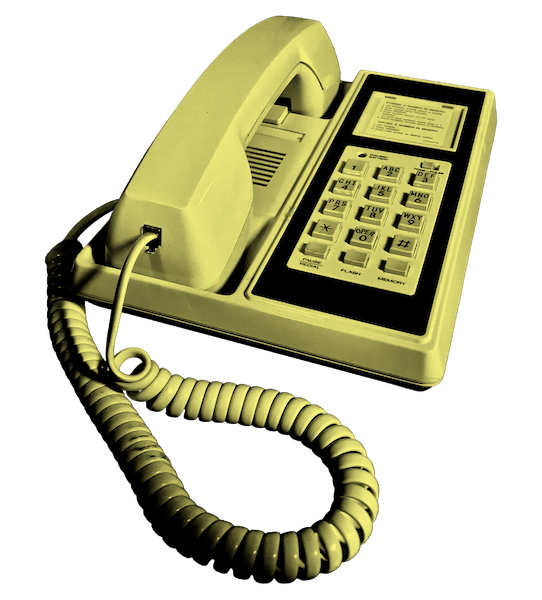
ISSUE 1: Landline
Research underway.
Work with us:
Fund the next phase of research
Partner on research, design, or public programming
Commission an issue about a technology you care about
Suggest a future object